General Contractor Markup: Everything You Need to Know


Reviewed in June 2026
Did you know that the average general contractor markup on labour is 25% and higher, and on materials, it can be as high as 50%?
What does this imply for your business as a builder?
General contractor markup is one of the numbers that decides whether a job actually makes money. Materials, labour, subcontractors, supervision, insurance, office costs, and risk all need to be covered before profit is realised.
Many builders mark up labour, materials, or subcontractor costs without clearly separating overhead, profit, and contingency. That can make a bid look competitive at the start and still leave the business underpaid once the project is underway.
In this guide, we’ll break down how contractor markup affects your financial management workflows, how it differs from margin, what average markup ranges look like, and how builders can calculate markup in a way that protects cash flow and project profitability.
Table of Contents
- General Contractor Markup: Quick Answer
- What Is General Contractor Markup?
- The Average Markup for a Builder
- What Affects Contractor Markup?
- Contractor Markup by Cost Type
- Markup vs. Margin
- Calculating Your %: Contractor Markup Formula
- Use Construction Markup with Advanced Technology
- General Contractor Markup Types in Invoices
- Common Contractor Markup Mistakes
- Should the Clients Know About General Contractor % Markup?
TL;DR
- Markup refers to adding a percentage or fixed amount to the direct construction costs to cover indirect costs, overhead, and profit.
- Markup vs Profit Margin: Markup is added to the cost, whereas margin is subtracted from revenue.
- Defining general contractor markup can seem simple, but the process requires precise calculations and reliable construction software to ensure your business’s profitability.
General Contractor Markup: Quick Answer
General contractor markup is the percentage or fixed amount added to direct project costs to cover overhead, risk, and profit. A common markup range depends on project type, location, business size, and scope complexity.
Many contractors apply different markups to labour, materials, subcontractors, and allowances because each cost category carries a different level of risk and management effort. The key is to calculate markup from real overhead and profit targets, not from a random percentage copied from another builder.
What Is General Contractor Markup?
General contractor markup is the part of the price that turns project costs into a workable selling price. It helps cover the business costs that do not always appear as direct line items, including supervision, insurance, permits, office expenses, estimating time, project coordination, and warranty exposure.
The markup also protects the builder’s profit. Without it, the business may recover the cost of labour and materials but still fail to cover the cost of running the company.
Setting the right markup is a balance. A rate that is too high can make the bid harder to win. A rate that is too low can leave the builder exposed when costs move, scope changes, or the job takes more management time than expected. The goal is to price work in a way that stays competitive while still protecting the company’s overhead and margin.
The Average Markup for a Builder
There is no fixed answer to this question. Markup rates can vary significantly depending on the type of project, location, competition, and other factors. However, industry experts suggest that a general contractor should mark up labour costs by around 25% and more, and material costs should see a markup of approximately 30% to 50%.
The Construction Financial Management Association reveals that builders typically enjoy an average pre-tax net profit ranging from 1.4 to 2.4%. Conversely, subcontractors see a slightly higher average pre-tax net profit, falling between 2.2 and 3.5%.
However, it’s important to note that these figures, while they might seem decent, barely cover the inherent risks associated with the construction industry.
This slim profit margin is barely sufficient for many contractors to remain viable and sustain their operations. Thus, maintaining an appropriate markup on labour and materials is not just recommended but is vital for survival in the competitive environment of this sector.
What Affects Contractor Markup?
Contractor markup changes from one business to another because overhead and risk are not the same on every job. A small remodelling project, a custom home, and a commercial build may all need different markup decisions.
Common factors include:
- Project size and complexity
- Labour availability
- Material price volatility
- Subcontractor coordination
- Warranty exposure
- Supervision time
- Insurance and licensing costs
- Office overhead
- Schedule risk
- Local competition
A markup that works for one builder may be too low for another. The safest approach is to calculate the company’s real overhead first, then add the profit target needed to keep the business healthy.
Contractor Markup by Cost Type
Not every cost should be treated the same way. Labour, materials, subcontractors, equipment, and allowances each affect the job differently, so many builders apply different markup rules depending on the cost category.
Labour Markup
Labour markup usually needs to cover more than hourly wages. Payroll taxes, benefits, supervision, downtime, insurance, training, and management time all affect the real cost of labour.
If labour is marked up too lightly, the job may look profitable on paper while still failing to cover the full cost of keeping crews productive.
Material Markup
Material markup helps cover procurement time, delivery coordination, storage, waste, price changes, and administrative handling. Materials with higher volatility or special ordering requirements may need a different markup than common stock items.
Subcontractor Markup
Subcontractor markup usually reflects coordination, scheduling, supervision, communication, and risk. Even when a subcontractor performs the work, the builder is still responsible for managing the scope and protecting the client relationship.
Equipment Markup
Equipment costs may include ownership, rental, maintenance, fuel, transport, and downtime. Builders should avoid treating equipment as a pass-through cost if the business carries real responsibility for keeping it available and productive.
Allowance Markup
Allowances and client selections can create pricing problems if markup is unclear. Builders should define whether allowance markup covers only procurement and admin work or also installation, supervision, warranty risk, and schedule impact.
Markup vs. Margin
Yes, the terms are often interchangeable, but they are two different concepts.
Markup is the percentage added to a product or service’s cost price to reach the final price offered to clients. In contrast, margin is the difference between the final price of a product or service and its cost price.
In simpler terms, markup is added to the cost, whereas margin is subtracted from revenue.
For example, if you calculate your labour costs for a project at $10,000 and apply a 20% markup rate, your total charge to the client will be $12,000 ($10,000 + $2,000 = $12,000).
In this case, your margin will be $2,000 ($12,000 – $10,000 = $2,000), which is 16.6% of the final price. See the calculations below with the P denoting our margin percentage:
12,000 * P / 100 = 2,000
P = 2,000 / 120
P = 16.6%
Calculating Your %: Contractor Markup Formula
The process may seem tricky for some contractors.
But not you!
You can develop a comprehensive and profitable pricing strategy with the right approach.
First thing is to study this formula:
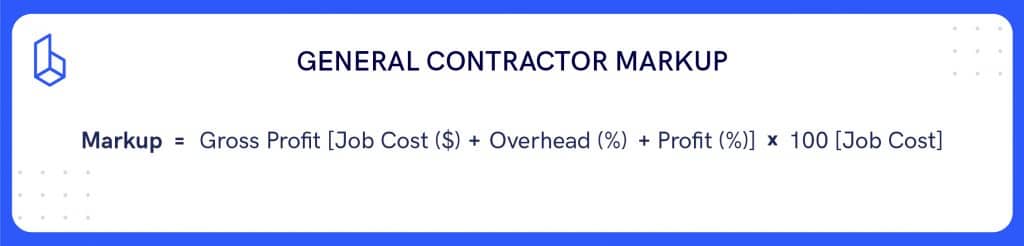
The idea is to determine a fair and sustainable gross profit margin for your business based on the market research in your area, project type, and size.
Then, you can allocate overhead expenses as a percentage of the job cost (including labour and material costs) to arrive at an accurate markup rate.
To better illustrate the relationship between markup and profit, consider this basic table that represents the necessary markup on costs to secure the profit you need to maintain daily operations:
- For a 15% profit, your markup on costs should be 17.65%.
- For a 25% profit, your markup on costs should be 33.33%.
- For a 35% profit, your markup on costs should be 53.85%.
- For a 40% profit, your markup should be 66.67%.
Now, let’s apply this in a real-world context.
Suppose your labour costs for a project amount to $10,000, and you decide to apply a 17.65% markup rate for a 15% profit. Your total charge to the client will be $11,765 ($10,000 + $1,765 = $11,765).
In this scenario, your profit margin will be $1,765 ($11,765 – $10,000 = $1,765), roughly 15% of the final price.
Include All Real Project Costs
To make things even simpler for you, here are some steps to help you calculate your markup:
Markup only works when the starting cost is accurate. Before applying markup, include the full cost of the work, such as:
- Materials and specialised equipment
- Labour, wages, payroll taxes, and benefits
- Subcontractor quotes
- Office overhead, rent, insurance, and administrative costs
- Supervision, coordination, and project management time
- Contingency for weather delays, price changes, rework, or extra labour needs
A markup rate copied from another builder will not protect your margin if your cost base is different. The safer approach is to calculate real job costs first, then apply a markup that covers overhead, risk, and the profit target.
Use Construction Markup with Advanced Technology
Calculating and adding the general contractor % markup to each item in the estimate can be a daunting task. It requires painstaking attention to detail, ensuring that each material, labour, and overhead cost is accurately accounted for and appropriately marked up.
This process can be time-consuming and prone to errors, especially when managing multiple projects simultaneously.
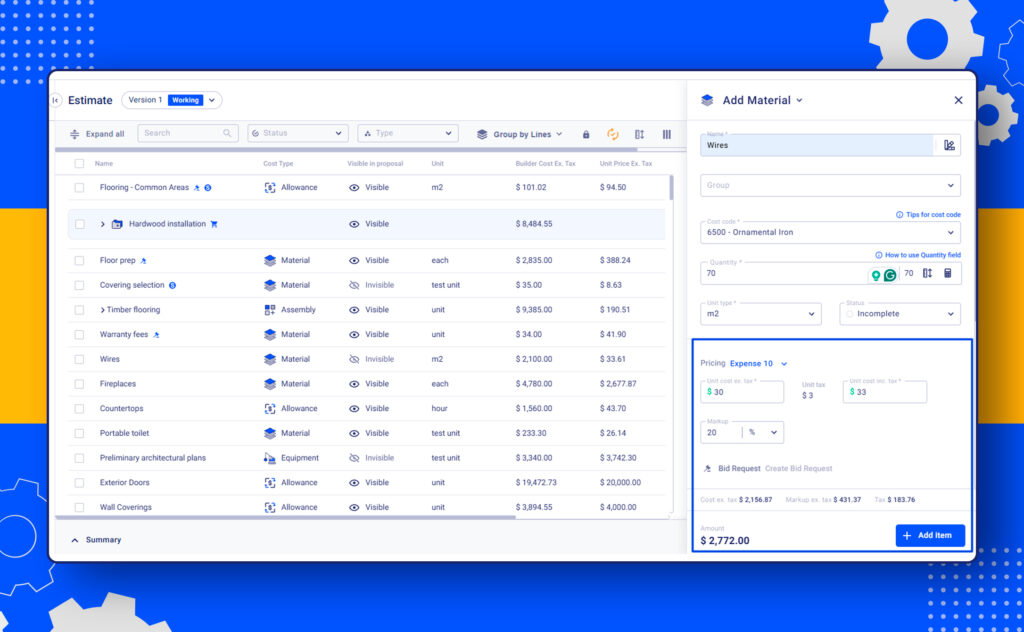
With construction management and estimating software, you can create accurate estimates, apply markup rates automatically, track project expenses, and generate WIP reports in a fraction of the time it would take to do it manually.
Buildern is designed to help general contractors work smarter while simplifying the markup application process and allowing you to focus on what you do best – constructing great buildings.
Benefits of Using Construction Software
- Customizable Markup Rates: Tailor markup rates to specific items, ensuring your estimates are competitive and profitable.
- AI-Assisted Quantity Recognition: Automatically detect and organize quantities from drawings or takeoffs, helping reduce manual counting errors and speeding up estimate preparation.
- Historical Cost Pattern Analysis: Analyze previous project data to identify cost patterns and typical price ranges, helping estimators validate assumptions before submitting bids.
- Automated Cost Code Structuring: AI-assisted categorization organizes estimate items under consistent cost codes, making budgets easier to track once the project moves from estimating to execution.
General Contractor Markup Types in Invoices
Markup not only affects the estimate. It also affects how the invoice is structured, how clearly costs are explained to the client, and how easily the builder can defend the final amount billed.
The right invoice format depends on the contract type. Some projects require a transparent cost-plus structure, where markup is shown separately. Others use fixed-price billing, where markup is already built into the agreed project price. The important part is consistency. The invoice should match the estimate, contract terms, change orders, and any allowances approved during the job.
Cost-Plus Pricing
In this pricing model, contractors bill their clients for the actual cost of labour and materials plus an added percentage that covers overhead expenses and profit. It’s a transparent way to price projects, as customers know exactly what they are paying. However, it may not always be profitable for the contractor if costs exceed estimates or clients negotiate too hard on percentages.
The risk is that cost-plus billing needs clean documentation. If receipts, subcontractor bills, allowance changes, and field updates are not organized, the invoice can become difficult to explain. Builders should also define how markup applies to different cost categories before the work begins.
Fixed Price Markup
In this pricing model, contractors agree with clients on a fixed price for the entire project, regardless of actual costs. The advantage is knowing exactly how much you will make before starting work. However, this pricing model may not be suitable if your cost estimates are inaccurate or if unforeseen expenses arise.
If the estimate is too low, material costs change, or the job takes more time than expected, the builder may absorb the loss unless the scope changes are handled through approved change orders.
For this reason, fixed-price invoices should stay closely aligned with the original contract, payment schedule, allowances, and approved changes.
TIP: You can also use hybrid markups, which combine cost-plus and fixed-price markup models to provide a more accurate pricing strategy for your business. It allows you to charge clients the actual costs for labour and materials, plus a fixed amount that covers overhead expenses and profit.
Keeping Markup Consistent Across Estimates and Invoices
Markup problems often appear when the estimate, change orders, and invoice are managed in separate files. A markup rule may be applied one way in the estimate, adjusted manually in a change order, then entered differently in the invoice.
This is where connected construction management software can help. In Buildern, estimates, allowances, change orders, invoices, and project cost tracking can stay part of the same workflow. That makes it easier to keep markup rules consistent from the approved estimate through final billing.
Common Contractor Markup Mistakes
Markup problems usually show up after the job starts, when the estimate becomes a budget and real costs begin to move.
Treating Markup and Margin as the Same Number
A 20% markup does not create a 20% margin. Confusing the two can lead to underpricing, especially when overhead and profit targets are already tight.
Using the Same Markup on Every Cost
Labour, materials, subcontractors, equipment, and allowances do not carry the same risk. Applying one flat markup to every cost may be simple, but it can distort the real profitability of the job.
Forgetting Overhead
Office salaries, insurance, software, vehicles, rent, phones, accounting, and estimating time still need to be paid. If overhead is not included in the markup strategy, the business may win work and still lose money.
Marking Up Only Visible Costs
Some costs are easy to miss because they do not appear as a line item on the job. Supervision, rework, callbacks, warranty exposure, and coordination time should still be reflected in pricing.
Letting Clients Negotiate Markup Without Context
Clients may ask for a lower markup without understanding what it covers. Builders should be prepared to explain their pricing structure clearly, especially on cost-plus or open-book projects.
Should the Clients Know About General Contractor % Markup?
Ideally, your markup cannot and should not be negotiable.
However, developing trust and co-dependency is vital for any contractor-client relationship. Hence, good communication and transparency are essential to maintain a healthy business.
Yet, some clients don’t want to know the markup percentage for their projects, and contractors usually don’t share this information unless required.
However, contractors should be transparent about their pricing methods if a client asks. Clients may also wish to negotiate on margins or ask for cost breakdowns, making it essential for contractors to understand clearly how they calculate markups and margins.
Final Thoughts
So, what’s your answer to my main question?
Are you charging enough to impact your profitability positively, or are you potentially being underpaid?
Having navigated through this comprehensive guide, you should now be equipped to answer this critical question confidently.
With a firm grasp of the concepts discussed and construction financial management software, you can now accurately determine if your current pricing strategy is optimizing your revenue stream or if you’re underselling your services.

What Is a Good Markup Percentage?
A normal builder markup depends on overhead structure, business size, and risk exposure. Many builders apply a markup between 10% and 30% to cover operating expenses and ensure a stable profit. High-risk or highly specialized work may require a higher markup to compensate for warranty exposure, schedule uncertainty, or market volatility.
How Does Markup Differ From Margin?
Markup is the percentage added on top of direct job costs to cover overhead and profit. Margin is the profit percentage based on the final selling price. Builders often confuse these two, which can lead to underpricing. A precise estimating workflow helps keep both calculations aligned with company targets.
Does General Contractor Markup Change Depending on Project Type?
Yes. Remodels, custom builds, and commercial jobs carry different risks, overhead requirements, and labour productivity rates. Builders typically adjust markup to reflect complexity, number of stakeholders, and the amount of coordination needed. Tracking historical job costing data helps establish the right markup range for each project type.